
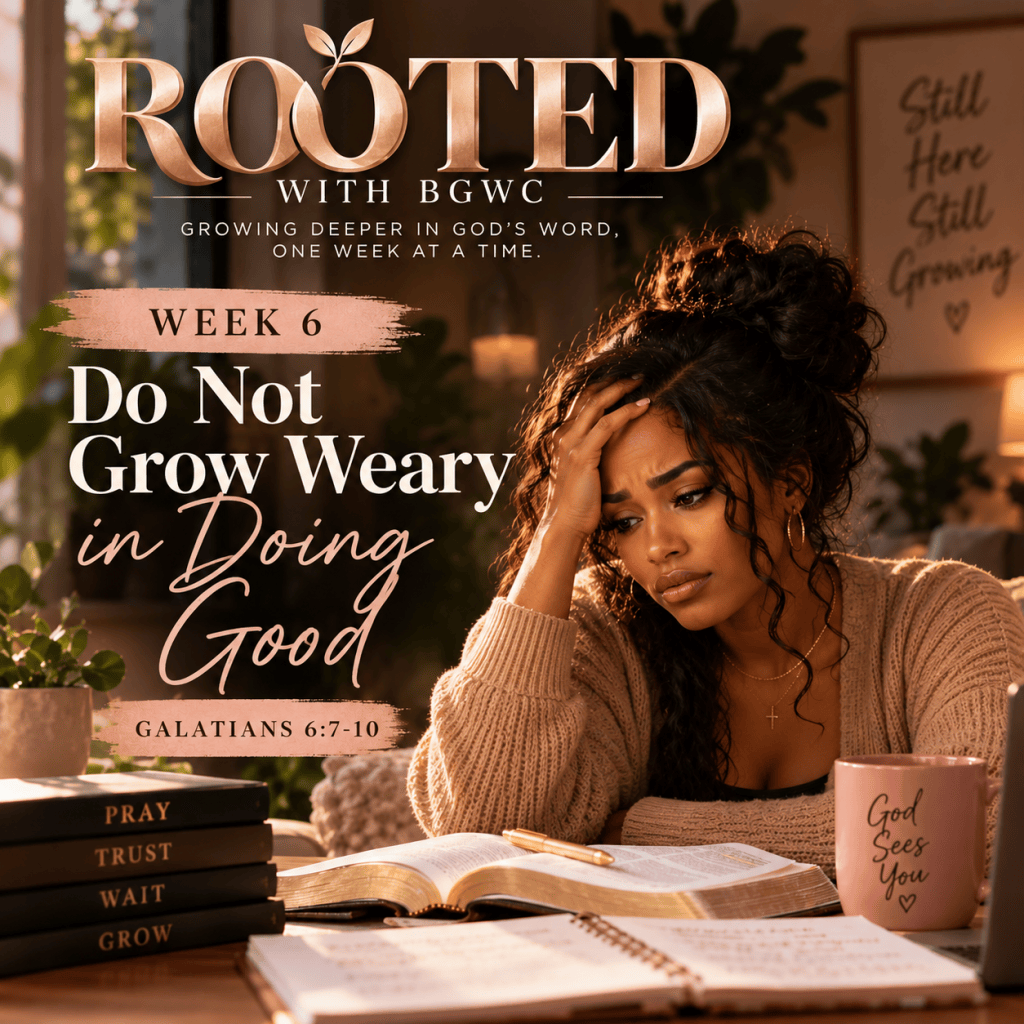
Main Scripture: Galatians 6:7-10, CSB
Growing Deeper in God’s Word, One Week at a Time.
When You Are Doing Your Best but Nothing Seems to Be Changing
Have you ever reached a point where you wondered whether all the effort you were putting into your life was actually making a difference? Perhaps you have been trying to improve your circumstances, repair a relationship, grow spiritually, build healthier habits, or work toward a goal that means a great deal to you, yet every time you look around, it seems like you are standing in the same place you started. You keep showing up, keep trying to make better decisions, and keep asking God for direction, but the progress you hoped to see has been hard to recognize. After a while, even the smallest responsibilities can begin to feel heavier because you are not only managing the demands of everyday life, you are also carrying the disappointment of wondering when your efforts will finally produce something different.
Imagine a woman named Renee who has spent the past several months trying to rebuild her life after a particularly difficult season. She has been working hard at her job, helping her family, trying to become more intentional about her relationship with God, and making an effort to respond to people with greater patience than she once did. In the past, when someone disappointed her, she would immediately react out of frustration, but she has been learning to pause, pray, and choose her words more carefully. She has also started setting healthier boundaries because she recognizes that constantly saying yes to everyone has left her emotionally exhausted and unable to give proper attention to the responsibilities that matter most.
At first, Renee feels encouraged by these changes because she knows she is making a genuine effort to live differently. She begins to notice that she is not reacting as quickly when she feels offended, and she is learning to think more carefully before making decisions. However, as the weeks pass, the people around her do not seem to respond in the way she expected. Some continue to take her kindness for granted, others misunderstand her boundaries, and a few even suggest that she has changed in ways that make her less available to them. At work, she continues carrying responsibilities that leave her feeling overwhelmed, and at home, she still has bills to pay, problems to solve, and family concerns that do not disappear simply because she is trying to grow spiritually.
Eventually, Renee begins questioning whether her efforts are worth it. She wonders why she is working so hard to become more patient when other people continue behaving in ways that frustrate her, and she questions why she should keep treating people with kindness when some of them seem determined to misunderstand her intentions. She even begins to wonder whether she is making any real progress in her relationship with God because her circumstances have not changed as quickly as she hoped.
One evening, after another frustrating day, Renee sits quietly and thinks about everything she has been trying to do differently. She remembers the conversations in which she chose patience, the moments when she resisted the urge to retaliate, and the difficult decisions she made to protect her peace without intentionally hurting anyone else. Instead of celebrating those moments, she begins focusing on what she has not received in return. She has not received the apology she wanted, the support she hoped for, or the relief she expected from her circumstances, and she starts feeling as though her efforts have been wasted.
Renee’s struggle is not simply that life has been difficult. Her deeper struggle is that she has begun measuring the value of her faithfulness by how quickly other people change and how soon her circumstances improve. Without realizing it, she has started allowing the absence of visible results to determine whether she believes her choices matter.
Perhaps you can recognize a little of yourself in Renee’s experience. Maybe you have been trying to do the right thing while dealing with circumstances that continue to test your patience, or perhaps you have been working toward a goal for so long that you have begun questioning whether you should continue. You may have been praying for a breakthrough, trying to grow through a difficult relationship, working to improve your financial situation, or making changes that require discipline and consistency, yet the outcome you hoped for remains beyond your reach.
When life begins to feel this way, it is easy to believe that the answer is to stop trying, withdraw from everyone, or return to the habits you were working so hard to change. However, God’s Word invites us to consider a different response, one that does not deny our weariness but teaches us how to remain faithful without allowing disappointment to control our decisions.
This is where our Week 6 study begins, with a passage of Scripture that speaks directly to the struggle of doing good when the results are not immediately visible.
Understanding the Scripture: Galatians 6:7-10
In his letter to the Galatians, the Apostle Paul addresses believers who need clarity about what it means to live in the freedom they have received through Jesus Christ. Throughout the letter, Paul explains that people are made right with God through faith in Christ rather than by attempting to earn righteousness through their own efforts to keep the law. At the same time, he makes it clear that Christian freedom is not permission to live selfishly or disregard God’s instructions. Instead, believers are called to walk by the Holy Spirit, love others, and allow their lives to reflect the transforming work of God.
By the time Paul reaches Galatians 6, he begins offering practical instructions about how believers should treat one another and take responsibility for their conduct. He discusses restoring someone who has fallen into sin with gentleness, carrying one another’s burdens, examining our own actions, and recognizing the importance of personal responsibility. His teaching about sowing and reaping appears within this larger conversation about how faith should influence the way Christians live.
Paul uses the familiar image of planting and harvesting to explain a spiritual principle. The seeds a person plants matter because they influence the kind of fruit that eventually grows. When people consistently surrender their decisions to selfish desires and sinful patterns, those choices can lead to destruction. When they walk according to the Holy Spirit, they cultivate a life that reflects God’s direction and leads toward what Paul describes as eternal life.
This principle reminds us that our daily choices are not insignificant simply because they seem ordinary. The way we respond when we are frustrated, the words we choose when someone disappoints us, the honesty we practice when dishonesty would be easier, and the priorities we establish when life becomes demanding all contribute to the direction of our lives.
However, we must understand this passage carefully. Paul is not teaching that every painful experience is a punishment for something a person has done, nor is he promising that every good decision will produce financial success, an easy life, or immediate recognition. Faithful Christians still experience disappointment, injustice, grief, and seasons of uncertainty. Doing what is right does not give us control over every outcome, because other people’s decisions and circumstances beyond our influence can affect our lives in ways we cannot prevent.
Instead, Paul is reminding believers that they are responsible for the way they live, even when they cannot control everything that happens around them. We cannot always determine what others will do, but we can seek God’s wisdom concerning how we respond. We cannot force every opportunity to open, but we can continue preparing ourselves to act wisely when opportunities arise. We cannot guarantee that everyone will appreciate our kindness, but we can choose to treat people with dignity because we belong to Christ.
This understanding becomes especially important when we reach Galatians 6:9, where Paul encourages believers not to grow weary in doing good because there is a harvest in its proper time if they do not give up.
Paul acknowledges a reality that many believers experience but may hesitate to admit. Doing good can become tiring. Choosing patience when you feel frustrated requires effort, maintaining integrity when others compromise can be difficult, and continuing to serve when your work goes unnoticed can leave you wondering whether anyone recognizes what you are contributing.
The instruction not to grow weary is not a declaration that Christians should never feel tired, disappointed, or emotionally drained. Paul is encouraging believers not to allow weariness to become the reason they abandon faithful living. There is a difference between recognizing that you need rest and deciding that doing good is no longer worth the effort. There is also a difference between changing an unhealthy pattern and giving up on the values God has called you to practice.
When Renee begins questioning whether her growth matters because other people have not changed, she needs to remember that her responsibility is not to control their behavior. Her responsibility is to remain accountable for her own choices while asking God for wisdom about the relationships and circumstances she faces.
Her patience is still valuable even if someone remains difficult. Her boundaries are still necessary even if someone disagrees with them. Her commitment to integrity still matters even if another person chooses dishonesty. The value of her obedience cannot be determined solely by whether she receives the response she wanted.
Paul concludes this section by encouraging believers to do good to everyone whenever they have the opportunity, with particular attention to those who belong to the household of faith. This reminds us that faithfulness is not reserved for major achievements or public acts of service. It is also expressed through the ordinary decisions that shape our character, influence our relationships, and demonstrate the sincerity of our faith.
The heart of this passage is that we are called to remain faithful in the way we live, even when we cannot determine when or how the results will appear.
The Problem: When You Begin Measuring Your Faith by Your Results
One of the greatest challenges of remaining faithful is learning how to separate obedience from the outcome we hope to receive. We often begin a new habit, pursue a goal, or make a difficult change because we believe it will lead to a better situation. We expect that if we work hard, remain patient, treat people well, and make responsible decisions, our circumstances will eventually improve in ways we can clearly recognize.
Although our choices can influence many areas of our lives, we cannot guarantee that every good decision will produce the exact result we desire. Sometimes, we do everything within our control and still encounter rejection. Sometimes, we approach a relationship with sincerity, but the other person is unwilling to accept responsibility for their behavior. Sometimes, we work diligently toward a goal only to discover that the opportunity we wanted is no longer available or that our original plan needs to change.
When these experiences accumulate, disappointment can begin to affect the way we interpret our lives. We may assume that a lack of visible progress means we are doing something wrong, that God is ignoring our prayers, or that continuing to make an effort is pointless. We can become so focused on what has not happened that we fail to recognize what is changing within us.
Think again about Renee. Her circumstances have not improved as quickly as she expected, but that does not mean nothing has changed. She is learning to respond rather than react, recognize unhealthy patterns, establish boundaries, and consider the consequences of her decisions before acting. These are meaningful changes, even though they have not immediately transformed the people around her or removed every difficulty she faces.
Her problem is that she has overlooked the growth happening within her because she has been waiting for external evidence that her efforts are working. She wants the people around her to become more considerate, but she has not fully recognized the value of becoming more intentional about her own responses. She wants her life to feel easier, but she is learning skills that may help her navigate difficult circumstances with greater wisdom, whether or not those circumstances change immediately.
This is a trap many of us can fall into when we become discouraged. We begin treating visible results as the only evidence that our efforts matter, and we forget that growth often includes changes in our character, understanding, habits, and ability to respond faithfully.
The solution is not to ignore our circumstances or pretend that disappointment does not hurt. It is to stop allowing our circumstances to become the only measure of our progress. We can acknowledge that something is difficult while also recognizing where God is teaching us, correcting us, strengthening us, or helping us make wiser decisions.
We must also be willing to examine whether our expectations are healthy. If Renee expects everyone to reward her kindness, she will remain vulnerable to disappointment whenever people fail to respond as she hopes. If she believes boundaries should immediately make every relationship easier, she may interpret resistance as proof that she has made the wrong decision. If she expects every faithful choice to lead to an immediate blessing, she may struggle to remain consistent when the outcome takes longer than she anticipated.
Doing good does not mean placing ourselves in situations where people can continually mistreat us. It does not mean giving without limits, accepting every request, or remaining silent when something needs to be addressed. Sometimes, the faithful choice is to establish a boundary, have an honest conversation, seek accountability, or step away from an unhealthy situation. The goal is not to make everyone happy with us, but to live in a way that honors God.
When we begin to understand this distinction, we can continue practicing patience without accepting mistreatment, remain generous without neglecting our responsibilities, and pursue our goals without allowing disappointment to determine our worth.
The Obstacles: What Makes Faithfulness Difficult?
Obstacle One: Comparison Makes Your Progress Feel Insignificant
Comparison can make an already difficult season feel even heavier because it encourages us to evaluate our lives through someone else’s experiences. You may be working diligently to improve your circumstances while watching someone else reach a milestone you have been praying about for years. You may be learning to establish healthy relationships while someone else appears to enjoy the kind of connection you have been longing for. You may be working to build something meaningful while another person’s efforts seem to produce results much more quickly.
When you focus too heavily on what someone else has achieved, it becomes easy to overlook the responsibilities, challenges, and opportunities that are unique to your own life. You may begin questioning your decisions, rushing into opportunities that are not right for you, or abandoning healthy habits because you feel as though you are falling behind.
Comparison can also influence the way you interpret God’s faithfulness. Instead of recognizing His work in your life, you begin measuring His goodness by whether your circumstances resemble someone else’s. You may know intellectually that everyone has a different journey, but emotionally, you can still feel discouraged when your progress does not match what you see around you.
The answer is not to pretend that you never notice another person’s success. It is to recognize when comparison is distracting you from your own responsibilities and drawing your attention away from what God has placed before you.
Galatians 6 reminds us that our choices matter because we are responsible for the lives we are cultivating. Rather than spending your energy trying to match someone else’s timeline, consider what faithfulness looks like in your own circumstances. Perhaps you need to develop a new skill, become more disciplined with your finances, improve your communication, or dedicate more time to your spiritual growth. Whatever the situation requires, you can focus on taking the next wise step instead of treating another person’s progress as evidence that you have failed.
You do not have to diminish someone else’s blessing to appreciate your own progress, and you do not have to rush through your season to prove that you are moving forward. You can celebrate what God is doing in someone else’s life while remaining committed to the responsibilities and opportunities in your own.
Obstacle Two: Discouragement Makes You Want to Return to Old Habits
When doing the right thing becomes difficult, old habits can begin to look appealing because they offer a familiar response to uncomfortable emotions. If you are accustomed to reacting quickly when someone offends you, choosing patience may initially feel unnatural. If you have spent years trying to please everyone, setting boundaries may leave you feeling guilty. If you are used to avoiding difficult conversations, addressing a problem honestly may feel much more uncomfortable than pretending it does not exist.
Renee experiences this struggle when she begins wondering whether her efforts to change are worth the frustration. Part of her wants to return to the familiar patterns she has been trying to leave behind because those patterns seem easier than continuing to practice patience and self-control. She may tell herself that there is no reason to keep trying when other people are not changing, but underneath that thought is a deeper desire to escape the disappointment she feels.
This is where we must remember that spiritual growth is not always comfortable. Sometimes, the process of living according to God’s Word requires us to respond differently from the way we naturally feel inclined to respond. It may require us to acknowledge our mistakes, apologize when we have caused harm, forgive someone without pretending their behavior was acceptable, or choose restraint when anger is demanding an immediate response.
The difficulty of these decisions does not automatically mean we are on the wrong path. It may mean we are learning to practice a different way of living, one that requires us to depend on God rather than allowing every emotion to determine our behavior.
However, we should not confuse growth with the need to tolerate every difficult situation indefinitely. If a pattern is harming you, seek wisdom about how to address it. If you need help, reach out to someone trustworthy. If you have made a mistake, acknowledge it and make the necessary correction. Faithfulness is not about repeating the same action regardless of the circumstances. It is about remaining willing to follow God’s direction as you learn what obedience requires in each situation.
Obstacle Three: You Want to Control the Timing of the Harvest
Waiting is difficult because it requires us to live with questions that have not yet been answered. We want to know when the situation will improve, when the relationship will heal, when the opportunity will appear, or when the effort we have invested will begin producing results. We often feel more comfortable when we can identify a clear timeline, but many parts of life do not provide that kind of certainty.
When we become impatient with the process, we may start forcing outcomes, making decisions out of fear, or abandoning our responsibilities because we are tired of waiting. We might accept an opportunity that is not wise simply because we want something to change, or we may stop preparing for the future because we assume that nothing will work out.
Paul’s teaching about sowing and reaping reminds us that there is a relationship between faithful living and the fruit it produces, but the passage does not give us permission to dictate God’s timetable. His words encourage perseverance without promising that every desired outcome will arrive according to our expectations.
This distinction is important because Christian hope is not a guarantee that every personal plan will succeed exactly as imagined. Our hope is rooted in God, whose character remains trustworthy even when we do not understand our circumstances. We can trust Him while continuing to make responsible decisions, and we can remain open to His direction when the next step looks different from the one we originally expected.
For Renee, this may mean continuing to practice healthy communication while recognizing that she cannot force other people to change. It may mean reviewing her responsibilities and making practical adjustments rather than waiting for someone else to solve every problem. It may also mean accepting that some relationships will require firmer boundaries and that some circumstances may not improve in the way she hoped.
Her task is not to control the harvest. Her task is to seek God’s wisdom, act faithfully, and remain willing to adjust her approach as she learns more.
The God-Centered Solution: Keep Planting the Right Seeds
The answer to weariness is not simply to work harder or demand more from yourself. If you are already exhausted, adding more pressure will not necessarily help you live more faithfully. Instead, you must return to God and allow His Word to shape the way you understand your responsibilities, your expectations, and your next steps.
Start by examining what you are planting in your everyday life. Consider your conversations, habits, decisions, and responses, particularly in the areas where you feel most discouraged. Ask yourself whether your choices reflect the character of Christ or whether frustration has begun leading you toward resentment, dishonesty, avoidance, or unhealthy patterns.
This examination should be honest, but it should not become an opportunity to condemn yourself. God does not call you to grow through shame or to pretend that you never struggle. Through Jesus Christ, you receive grace that allows you to acknowledge where you need to change, seek forgiveness when necessary, and continue learning to live according to God’s Word.
Next, identify what is actually within your responsibility. You can choose how you communicate, whether you follow through on a commitment, how you prepare for an opportunity, and whether you seek wise counsel when you face a difficult decision. You can take responsibility for your mistakes, establish appropriate boundaries, and become more intentional about the habits that influence your life.
You cannot, however, control every person’s response, guarantee a particular outcome, or determine the exact timing of every opportunity. Trying to control those things can leave you emotionally exhausted because you are constantly attempting to manage circumstances that do not belong entirely to you.
When Renee begins to understand this, she can stop treating other people’s behavior as the measure of her growth. She can recognize that she is responsible for practicing patience, but she is not responsible for making everyone respond positively to her boundaries. She can continue showing kindness while becoming more discerning about the relationships she invests in. She can remain committed to her responsibilities while acknowledging that she needs rest, support, or a different approach.
This is what a God-centered response looks like in everyday life. It does not deny the problem, ignore the obstacles, or promise that everything will suddenly become easy. Instead, it brings the problem before God, examines it through the truth of Scripture, and identifies the next faithful action.
Sometimes, that action will be perseverance. At other times, it will be correction, rest, seeking help, or changing direction. The goal is not to remain attached to a particular plan simply because you have invested time in it. The goal is to remain faithful to God as you discern what wisdom and obedience require.
Finally, learn to recognize growth that does not immediately change your circumstances. Perhaps you are responding more thoughtfully, managing your responsibilities more consistently, recognizing unhealthy patterns sooner, or learning to make decisions without allowing fear to control you. These changes deserve attention because they can influence the way you navigate future challenges and relationships.
You do not have to pretend that your circumstances are better than they are. You can acknowledge what still needs to change while remaining grateful for the ways you are learning to live more faithfully. You can hope for a different outcome without treating your current season as proof that your efforts have been wasted.
Your responsibility is to plant faithfully, seek God’s direction, and remain willing to grow. The harvest is not something you can force, but the choices you make today are still worth taking seriously.
Practical Life Application: Bringing Galatians 6 Into Your Everyday Decisions
This week, choose one area of your life where discouragement has begun influencing your decisions. It might be a relationship that requires patience, a responsibility you have been avoiding, a goal that is taking longer than expected, or a habit you have struggled to maintain. Instead of attempting to change every part of your life at once, focus on understanding the situation and identifying what a faithful response would look like.
Begin by describing the problem honestly. What has been happening, what makes it difficult, and what emotions have you been experiencing as a result? Be specific about the obstacles rather than reducing everything to the statement that you are tired. Perhaps you are tired because you have been giving more than you can reasonably sustain, or perhaps you have been measuring your progress by someone else’s expectations. Identifying the actual problem will help you determine whether you need to persevere, change your approach, establish a boundary, or seek support.
Next, examine your own choices without taking responsibility for everything that happens around you. Ask yourself what you can do differently, which habits are helping you, and which patterns may be making the situation more difficult. If you have contributed to the problem, acknowledge that honestly and consider what correction is necessary. If the problem involves another person’s behavior, recognize what is within your control and what is not.
Then, choose one practical action that reflects the teaching of Galatians 6:7-10. You might follow through on a responsibility you have neglected, offer encouragement to someone who is struggling, make a necessary apology, practice a healthier boundary, or dedicate time to preparing for a goal that matters to you. Make the action specific enough that you can carry it out, and choose something that reflects wisdom rather than pressure to prove your worth.
As you move through the week, resist the temptation to judge the value of your action solely by the response it receives. If you offer encouragement and the person does not respond, your kindness can still reflect your faith. If you establish a healthy boundary and someone disagrees, that disagreement does not automatically mean your decision was wrong. If you take a responsible step toward a goal and the result is not immediate, you can still learn from the experience and determine what to do next.
At the end of the week, review what you learned about yourself and your approach to the situation. Perhaps you discovered that you were trying to control an outcome you could not guarantee, or perhaps you recognized that a change in your habits was necessary. You may have realized that you need to ask for help, rest more consistently, or stop allowing another person’s choices to determine your emotional response.
The purpose of this exercise is not to produce a perfect week. It is to help you become more intentional about the seeds you plant and more willing to allow God’s Word to influence the way you live. Every day gives you opportunities to practice faithfulness, and you can continue learning through both your successes and your mistakes.
Activities for the Week: Put the Scripture Into Practice
These activities are designed to help you move beyond reading Galatians 6:7-10 and begin applying its message to the decisions, relationships, and responsibilities that shape your everyday life.
Activity One: The Seeds I Am Planting
Set aside time to write about one area of your life where you want to see healthier growth. It might involve your relationship with God, your communication with others, your finances, your career, or the way you respond when you feel disappointed.
Create three sections in your journal titled What I Am Planting, What I Need to Change, and What I Can Practice.
Under the first heading, identify the habits and choices you are currently making in that area. Under the second, write honestly about the patterns that may be working against the growth you desire. Under the third, identify two or three practical actions that would help you live more consistently with the principles of Scripture.
For example, if you are struggling with frustration in a relationship, you might recognize that you have been reacting quickly, avoiding honest conversations, or expecting another person to recognize your needs without communicating them. Your practical actions might include pausing before responding, expressing your concerns respectfully, and establishing a boundary where necessary.
Return to your journal at the end of the week and reflect on what you learned. The goal is not to judge yourself for every mistake, but to become more aware of the choices that influence the direction of your life.
Activity Two: Seven Days of Intentional Good
For the next seven days, intentionally choose one action each day that reflects kindness, integrity, generosity, patience, responsibility, or another quality that aligns with the teaching of Scripture.
On the first day, encourage someone who may be experiencing a difficult season. On the second day, complete a responsibility you have been putting off. On the third day, practice patience in a situation where you would normally become frustrated. On the fourth day, examine an area where you need to make a more honest or responsible decision. On the fifth day, offer help where you can do so without neglecting your own responsibilities. On the sixth day, take a practical step toward a goal that requires consistency. On the seventh day, reflect on what you have learned about faithfulness throughout the week.
You can adjust these actions to fit your circumstances, but make sure each one is intentional rather than something you do simply to complete a task. As you practice, remember that doing good is not about earning God’s love or guaranteeing a reward. It is about allowing your faith to influence the way you live.
At the end of each day, briefly record what you chose to do, what made the action difficult, and what you learned from the experience. Pay attention to the moments when you wanted to give up, seek recognition, or control the response you received. These observations can help you understand where discouragement influences your choices and where you may need to depend more intentionally on God’s wisdom.
Activity Three: Identify What Is Yours to Carry
Sometimes, we become weary because we are trying to manage responsibilities that do not belong entirely to us. We may spend hours worrying about another person’s decisions, trying to prevent every possible problem, or attempting to make circumstances unfold according to our expectations.
For this activity, divide a page into two sections titled My Responsibility and Beyond My Control.
In the first section, write the actions you can take, such as communicating honestly, preparing for an opportunity, following through on a commitment, asking for help, or making a wise decision. In the second section, identify the things you cannot guarantee, such as another person’s response, the timing of an opportunity, or the outcome of every effort.
Review what you have written and identify one responsibility that deserves your attention this week. Then choose one concern that you need to stop trying to control and bring it honestly before God in prayer during your personal time with Him.
This activity is not about becoming indifferent to the things that matter to you. It is about recognizing the difference between responsible action and exhausting yourself by trying to control what you cannot determine. You can care deeply about a situation while still acknowledging that your influence has limits.
Activity Four: Practice a Faithful Response
Think about a situation that has recently tested your patience or made you feel discouraged. Without focusing exclusively on what the other person did or what went wrong, consider how you responded and what you might do differently if a similar situation occurs again.
Write down what happened, what you felt, how you responded, and what a response shaped by Scripture might look like. Consider whether the situation calls for patience, an honest conversation, forgiveness, a boundary, accountability, or a change in your approach.
If you recognize that you responded in a way that did not reflect your faith, acknowledge it without making excuses. Where appropriate, consider whether an apology or another corrective action is necessary. If you were responding to harmful behavior, consider what support or boundaries may be needed to protect your well-being.
The purpose of this activity is to help you develop a more thoughtful response to difficult circumstances rather than allowing every uncomfortable emotion to determine your behavior. Growth often begins when we become willing to examine our part honestly and seek God’s wisdom about what should happen next.
Activity Five: Celebrate Growth You Can Actually See
At the end of the week, write down three ways you practiced faithfulness, even if your circumstances have not changed as much as you hoped. Perhaps you followed through on a responsibility, made a difficult but wise decision, responded with greater patience, or recognized a pattern you need to change.
Next, identify one lesson you learned about your expectations. Did you expect someone else to respond differently? Were you placing too much pressure on yourself? Did you assume that a lack of immediate results meant your efforts were pointless?
Finish by writing one sentence about how you want to approach the coming week differently. Make it a practical commitment rather than a promise that you will never struggle again.
This activity will help you recognize progress without pretending that every problem has been resolved. It will also remind you that faithfulness includes the willingness to learn, make adjustments, and continue seeking God’s direction when life does not unfold according to your expectations.
Reflection Questions: Examine Your Heart and Your Habits
Take some quiet time this week to consider the following questions. Be honest in your responses, and allow your reflections to lead you toward practical changes rather than leaving you focused only on what has been difficult.
- What area of my life has made me feel most discouraged recently, and what specific obstacles have contributed to that discouragement?
- How have I been measuring my progress, and have I allowed the absence of visible results to convince me that my efforts do not matter?
- According to Galatians 6:7- 10, what do my everyday choices reveal about the things I am cultivating in my heart and life?
- Have I been trying to control another person’s response or the timing of an outcome that is beyond my control?
- What habits, attitudes, or reactions do I need to examine honestly if I want to live more consistently with God’s Word?
- Is there a situation where I need to persevere, and is there another situation where wisdom requires me to change my approach, seek help, or establish a boundary?
- How can I continue doing good without expecting every person to appreciate my efforts or every circumstance to improve immediately?
- What is one practical action I can take this week that reflects faithfulness, integrity, patience, or love?
- How can I recognize the growth taking place within me while remaining honest about the circumstances that still need attention?
- What would change in my daily life if I focused more on obeying God in the decisions before me and less on trying to guarantee the outcome?
After reflecting on these questions, select the one that challenges you most and spend additional time considering your response. Sometimes, the most important part of studying Scripture is recognizing an area where our current habits, expectations, or attitudes need to change. Let that recognition become an opportunity to seek God’s wisdom and take a meaningful step forward.
Encouragement for the Week: Do Not Let Weariness Make Your Decisions for You
As you move through this week, remember that feeling tired does not mean you have failed, and experiencing disappointment does not mean your faith has no value. There will be times when you work diligently toward something and still have questions about the outcome, when you try to do the right thing and receive an unexpected response, or when you make progress in one area of your life while continuing to struggle in another.
Those experiences can be difficult, especially when you have been carrying responsibilities for a long time and desperately want something to become easier. You may wonder how much longer you can keep trying, whether your choices are making a difference, or whether you should stop investing your energy in something that has not produced the results you expected.
When those questions arise, return to the truth of Galatians 6:7-10. Paul reminds believers that the choices they make matter and encourages them not to abandon doing good simply because the process becomes tiring. His teaching directs our attention toward the way we live, the seeds we cultivate, and our willingness to remain faithful while trusting God with what we cannot control.
You do not have to keep pursuing every goal in exactly the same way, and you do not have to remain in every situation simply because you have already invested time and energy in it. Sometimes, wisdom requires a new approach, a difficult conversation, a healthier boundary, or the humility to recognize that you need help. Faithfulness is not stubbornly refusing to change. It is remaining committed to God’s direction as you discern what the next right step requires.
If you have been comparing your journey with someone else’s, give yourself permission to refocus on the responsibilities and opportunities before you. If you have been measuring your worth by the response you receive from others, remember that your identity is not determined by their approval. If you have been trying to control the timing of every outcome, acknowledge your limitations and ask God to help you make wise decisions without allowing uncertainty to consume you.
You may not see the entire harvest today, but you can still make decisions that reflect the person you desire to be in Christ. You can choose honesty when compromise seems easier, patience when frustration rises, generosity when you have an opportunity to help, and responsibility when it would be more comfortable to avoid a difficult task. You can also choose rest when you are exhausted, seek support when you need it, and make changes when your current approach is no longer wise.
Your faithfulness is not a performance designed to convince God to bless you, and it is not a guarantee that everyone will treat you well. It is the daily practice of living according to His Word because you belong to Him and desire for your life to reflect the character of Jesus Christ.
So, if you are walking through a difficult season, do not allow disappointment to convince you that you have nothing left to offer. Examine the seeds you are planting, take responsibility for the choices that belong to you, seek God’s wisdom about the obstacles you are facing, and remain willing to grow through the process.
You do not have to see the entire harvest to make a faithful decision today. Keep doing what is right, remain open to God’s direction, and remember that the way you live in this season matters, even when the outcome is still unfolding.
Closing Reflection: Keep Planting With Purpose
As we close Week 6 of Rooted With BGWC, I want you to remember Renee’s story and the lesson hidden within her struggle. She initially believed that her efforts were becoming meaningless because the people around her were not changing and her circumstances were not improving as quickly as she expected. She had overlooked the growth happening in her own life because she was waiting for other people and external circumstances to confirm that her choices were worthwhile.
Her experience reminds us how easily discouragement can shift our attention away from the responsibilities God has placed before us. We can become so focused on the harvest we want that we stop paying attention to the seeds we are planting, and we can become so disappointed by what has not happened that we fail to recognize what still needs to be done today.
Galatians 6:7-10 invites us to approach our lives differently by recognizing the importance of our choices, remaining intentional about doing good, and trusting God through the process. This does not mean we should ignore our problems, accept every difficult circumstance without question, or continue pursuing a plan that needs to change. It means we should approach our decisions with wisdom, allow Scripture to shape our responses, and remain willing to follow God’s direction even when we do not have every answer.
As you reflect on this week’s study, consider the seeds you want your life to produce. Think about the relationships you want to cultivate, the habits you want to strengthen, the responsibilities you need to approach more faithfully, and the ways you want your character to reflect Jesus Christ. Then consider what you can begin practicing today, without waiting for everyone around you to change or every circumstance to become easier.
You may not be able to resolve every difficulty this week, but you can choose to respond with greater wisdom. You may not be able to control the outcome of every effort, but you can take responsibility for your decisions. You may not know when a difficult season will end, but you can continue seeking God’s direction as you determine how to move forward.
Let this be the week you stop treating a lack of immediate results as proof that your efforts are meaningless. Let it be the week you become more intentional about the choices you make, more honest about the obstacles you face, and more willing to trust God as you take the next faithful step.
Thank you for joining us for Week 6 of Rooted With BGWC, where we are committed to growing deeper in God’s Word, one week at a time.
Keep planting good seeds, keep growing in your faith, and keep allowing God’s Word to guide the way you live. Your circumstances may not change all at once, but you can continue choosing faithfulness, wisdom, and love as you walk with Him.
With love and encouragement,
Rooted With BGWC
Extension of BGWC Collective Co.


Leave a Reply